The Man And His Work
Quote: “Ethiopians, that is, Negroes, gave the world the first idea of right and wrong and thus laid the basis of religion and all true culture and civilization.”
–Joel Augustus Rogers
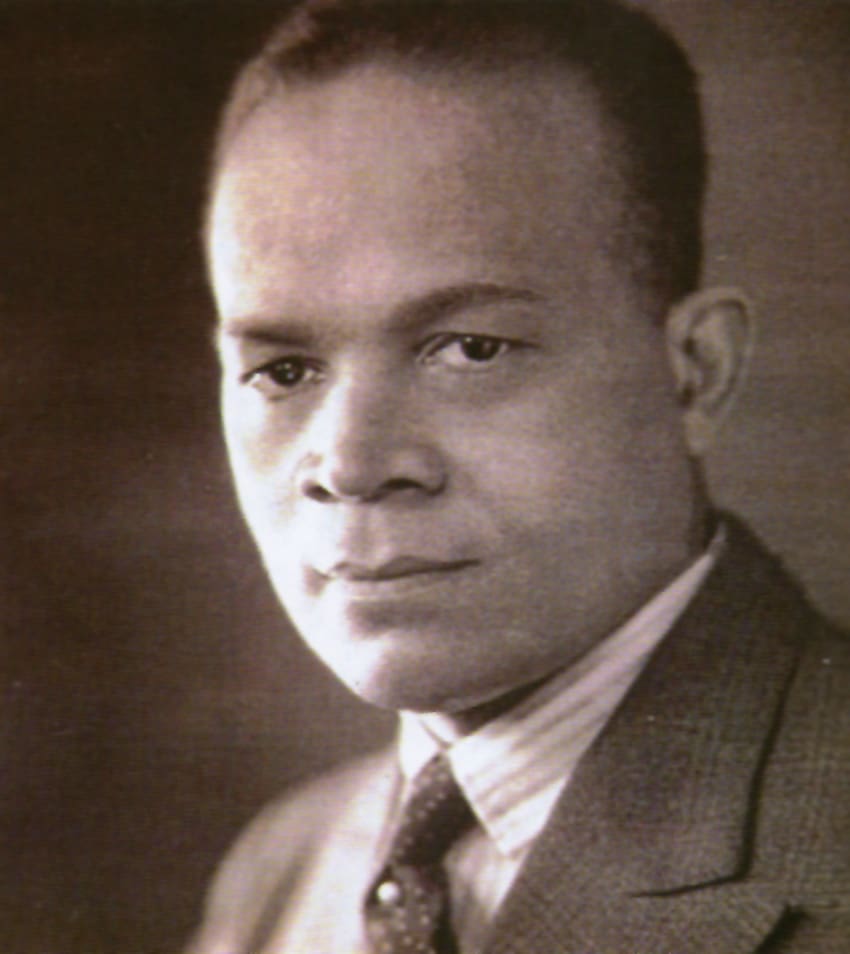
Joel Augustus Rogers (1883-1966) was a world traveler, a prolific writer, an accomplished lecturer, and the first Black war correspondent. Rogers became an anthropologist, historian, journalist and publisher. He was a scholar unparalleled in assembling information about African people, and probably did more to popularize African history than any single writer of the twentieth century.
J.A. Rogers, born in Negril, Jamaica, on September 6, 1883, was the son of a small town school teacher (his father). In 1906 he moved to the United States, settling for a while in Chicago but spending most of his life in Harlem, New York. In 1917 he became a naturalized U.S. citizen.
Rogers had known Marcus Garvey from their youth in Jamaica. In 1923 he covered the Marcus Garvey trial, and although never a member of the Universal Negro Improvement Association and African Communities League, of which Garvey was founder and President-General, he wrote regularly for the UNIA’s weekly newspaper, the Negro World, and lectured to local UNIA chapters.
A prodigious and meticulous detective, Rogers did exhaustive, primary research into the global history of African people. In 1925 he went to Europe for investigations in the libraries and museums there. In 1927 he returned to Europe for research lasting three years, and journeyed to North Africa during the same period. Between 1930 and 1933 Rogers continued his explorations in Europe, while in 1930, 1935 and 1936 he pursued his researches in Egypt and Sudan.
The year 1930 was indeed a high water mark in Rogers’ career, for it was in that year that Rogers went to Ethiopia as a correspondent for the New York Amsterdam News to attend the coronation of Haile Selassie I, who presented him with the Coronation Medal. It was also in 1930 that Rogers spoke at the international Congress of Anthropology held in Paris and opened by the president of France.
Rogers’ organizational affiliations included the Paris Society of Anthropology, the American Geographical Society, the American Association for the Advancement of Science and the Academy of Political Science.
For fifty years of his life, Rogers investigated and reported the accomplishments of ancient and contemporary African people and their place in history, contributing to such publications as the Crisis, American Mercury, the Messenger, the Negro World and Survey Graphic. To the Pittsburgh Courier Rogers contributed an illustrated feature entitled Your History.
When publishing houses refused to publish his works, undeterred, Rogers published them himself. All told, J.A. Rogers wrote and published at least sixteen different books and pamphlets. These publications became classic works–works that were circulated primarily in African communities. Rogers’ texts covered the entire spectrum of the global African community, from ancient and modern Africa, to Asia, Australia, the South Pacific, Europe and the Western Hemisphere.
Among Rogers’ most acclaimed and prominent works are: From Superman to Man, One-Hundred Amazing Facts About the Negro, The Real Facts About Ethiopia, Sex and Race, Nature Knows No Color-Line, and World’s Great Men of Color.