
Publications
Rogers’ first publication, From Superman to Man, was published in 1917 and focused on “the stupidity of racism.” The book was so well received that is was recommended for reading in the original Constitution and By-Laws of Garvey’s Universal Negro Improvement Association and African Communities League. Dr. Hubert Henry Harrison (1883-1927), himself a brilliant scholar and one of the greatest orators of the twentieth century, referred to From Superman to Man as “a genuine treasure,” and insisted “that it is the greatest book ever written in English on the Negro by a Negro.”
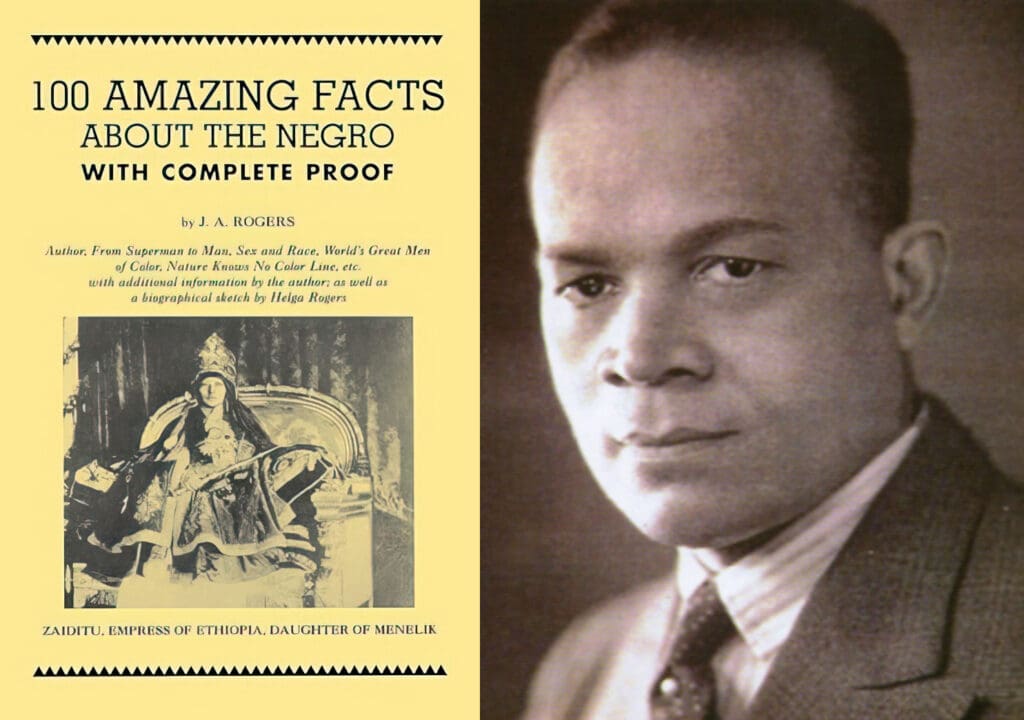
One Hundred Amazing Facts About the Negro With Complete Proof: A Short Cut to the World History of the Negro went through many printings and at least eighteen editions. A singularly provocative quote in One Hundred Amazing Facts About the Negro is by the English scholar and traveler Samuel Purchas (ca. 1575-1626)). According to Rogers, Purchas claimed that “of all (the kings of Ethiopia), Ganges was most famous, who with his Ethiopian army passed into Asia and conquered all as far as the River Ganges, to which he left that name.” This was a particularly interesting statement for me personally and helped catapult me on my own researches concerning the African presence in Asia. In the same book Rogers mentioned that “Beethoven, the world’s greatest musician, was without a doubt a dark mulatto. He was called `The Black Spaniard.'”
In 1935, dissatisfied with the reporting of news by the White press concerning the Italian invasion and occupation of Ethiopia, Rogers served as war correspondent in Ethiopia for the Pittsburgh Courier newspaper. After returning to the United States in 1936 he published a highly popular illustrated pamphlet entitled The Real Facts About Ethiopia. In The Real Facts About Ethiopia Rogers wrote that the Ethiopian woman “goes with her husband to war, and often becomes his avenger, should he fall. Usually she is fiercer in battle than the man. Europeans sometimes kill themselves, rather than fall into the hands of the African woman.”
Sex and Race was published in three volumes from 1941 to 1944. The first volume focuses on antiquity and is arguably the most fundamental of the three. As to ancient Asia, for example, Rogers devoted several pages of Sex and Race to the Black presence in early Japan. In the process he cites the studies of a number of accomplished scholars and anthropologists, raising the question “were the first Japanese Negroes?”
Other chapters are devoted to “The Negro in Ancient Greece,” “Negroes in Ancient Rome and Carthage” and “Were the Jews Originally Negroes?” The appendices of Sex and Race are equally fascinating, focusing on “Black Gods and Messiahs” and the “History of the Black Madonnas.” In Volume Two of Sex and Race Rogers examines “racism and race-mixing in the New World,” while Volume Three of Sex and Race seeks to define the concept of race itself. Like most of his works, all three volumes of Sex and Race are lavishly illustrated.